

LATEST ARTICLES
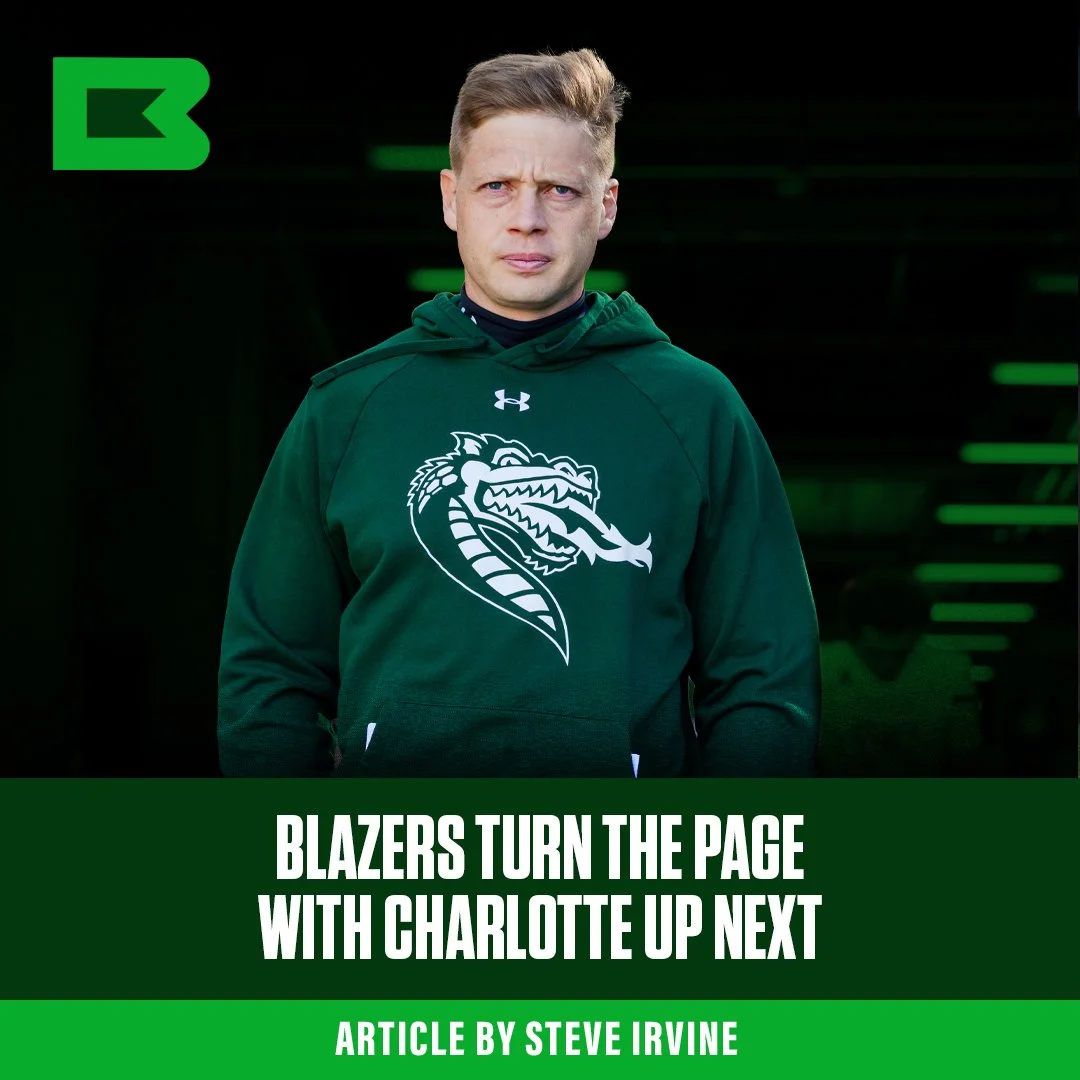
The UAB football team is looking to get back on track in what has become every season’s most special game of the year.
On Monday, UAB head coach Alex Mortensen held his weekly press conference to talk about last Saturday’s loss at South Florida and look ahead to the this weekend’s Children’s Harbor game against Charlotte. It will be the 10th time that UAB will play in the game that honors the kids of Children’s Harbor.
On the loss at South Florida: Very disappointing game against South Florida. Defensively, I thought we played really well. There was a point where they had some quarterback runs, there were some play extensions as well. But we got a pretty good handle on that. The defense played a really good game. Frankly, we just not play well on offense. It was really not a good performance outside of a few drives. I think there is a couple of things for us to learn from, more than a couple. One is, if we’re not going to play well, at a bare minimum let’s not beat ourselves, particularly in a game where our defense is playing really well. We had two sack fumbles where we gave them 14 points and of course we ended up missing two field goals as well. Let’s go back to the ECU game where it was a little bit of a tough game and very similar in a lot of respects but we didn’t beat ourselves that game and it gave us a chance to win at the end. You can imagine a little bit if we don’t give them 14 points (and) we make our field goals. It’s an ugly game, we’re not playing well but we have a chance to compete and win late. That’s something you can learn from. But here’s the deal, the objective is to be far better than that. The objective is not to play an ugly game and play so-so on offense and keep it close. But that needs to be the floor. But we want to be far better than that and that’s the expectation. I believe we’re capable of that. Obviously, we’re going to look at everything.
Sack fumbles, yes the quarterback’s got to protect the ball. Ryder knows that. If he is getting sack he’s got to protect it or he’s got to have a plan to throw it away. On the other side of it, too, for us to play better in totality, not just those two plays, we have to control the line of scrimmage better. I think anyone that watched the game and knows anything about football recognized that we got to control the line of scrimmage better in the running game and the passing game. At the bare minimum we’ve got to do one or the other. Because of that right now we’re playing far more conservative than I would ever like to play. I would like to be far more aggressive than we are, particularly on early downs. In terms of pass protection things, there’s a lot of ways (to look at it). One, we’re still developing. That’s one thing I’m confident in is that we’ll continue to develop players through the course of the season. But we do have tools to help our guys. We have tools to help our tackles with extra protection, with the ability to chip and nudge. But there are also tradeoffs with that too. When you add people to protection, you are going to stretch zone coverages slower, which is OK. Those are tools we have used at different points this year. Now, on the flipside, when you get people out faster and you stretch those zones quicker we have to understand we’ve got to get the ball out quicker. You can’t live in the middle there where we’re running a slow developing route and we’re not giving our o-line help or we’re holding on to the ball too long. We have to process quick and have an awareness of what we’re doing in protection.
On his team’s character during games: "One thing that's been pretty consistent this season is the character of the team has been very positive in terms of fighting, playing to the end, our toughness. I think you saw that really in a lot of areas and that's something we certainly don't want to take for granted. But I also want to be clear — we're not really interested in stopping there. That is an important part of our program, building and developing the character and a team that plays really hard and a team that plays together and sticks together. But we want to accomplish far more than that in the short term and to the remainder of this season in 2026, and then over the long term in terms of development and the longevity of this program."
On Charlotte: "Coach Tim Albin has been there. He's in his second year. He had a great program at Ohio. He's had an outstanding coaching career. And their team, I think, has really improved, particularly in the last couple weeks, and you've seen them really get better on offense. They beat Temple, and then they took Tulane into overtime last week or in their last game. So they're playing very, very well, and their offense is improving fast. Conner Harrell, who's got Birmingham ties — I remember him when he came out of high school — he's playing really well for them. We're playing them at home at 2:30. It'll be at Protective, so really excited to be there."
On his confidence in Ryder Burton and the offense: "The only other thing I’ll say before I kind of move on is I still really have a ton of confidence in our players obviously, but particularly our offensive players. I want to remind everyone that we're not that far removed from one of the best two-minute (offense) and overtime performances I've ever been a part of, with Ryder Burton staring down the gun barrel, making a lot of tough throws as he's taking shots. And not just his intangibles to perform well in a situation like that, but also his physical traits to make some really big throws and make some really good runs and play with courage. So I love the guys we got and I'm excited to go to work with them here going forward through this next stretch and particularly this week."
On the Children’s Harbor game: “We're celebrating 10 years at Children's Harbor and a partnership at UAB. It's a great tradition. It's a great cause. I think people that are affiliated with our program or, or supporters are aware of it. I really can't go into the entire scope of what they do, but it's really incredible. As I've gotten to know it, being a part of our program here, it's really very meaningful to me. You go back to 2017, when this partnership really started. The first game was when Coach Clark was here and Coach Clark was obviously instrumental in helping establish this. The idea that the players are going to have a child's name on the back of their jersey, and this week we're playing for the name on the back. You're really representing children and families who face some pretty significant challenges, far beyond the scope of football. So, 99 children are going to be represented. I think one of the best things about this is the relationship that gets created through the player and their families. One of the things we talk about is we want to develop the people in our program. We want to develop them as, one, individual people, two, students and then three as football players. From a character standpoint, I think one of the important things is that there's a component of getting out of yourself and serving other people, helping other people.
This is a really neat thing. My first game as a head coach here, as an interim, was the Children's Harbor game, something I'll probably always remember. Anytime we have an opportunity to work with them, I’m really grateful and appreciative of that. They were out at our golf tournament. I could talk about a lot of things that they've done that's been incredibly supportive. As I've gotten to know people in their organization, I just really respect what they do. The relationships with these families are really what makes it special.”
On explaining the difference in a good offensive first quarter and three struggling quarters at South Florida: “I think it's a great question. Look, we probably at times have done a good job with our opening script. That can be the planning of it, what you're doing schematically, and then some of it is I think it helps the players because they kind of know what is coming and they can really prepare for it. I think we've got to do probably a better job of taking ownership of the whole game plan, in terms of we got to help our players do that better. Obviously we practice these things all week. But as we move out of those (opening drives), still having the same confidence in our ability to execute with speed and aggressiveness that maybe we show like we did in the first half of the Memphis game or the first two drives of the last game. That's a part of it. At the same time, too, like, we can't absolve responsibility of ourselves as coaches either. Like, are we doing the right things beyond the, the initial part of the game? It's a gross oversimplification to say, ‘Well, we keep doing the same things (and) the opponent adjusts.’ But, that's something you can't gloss over either because as I said earlier, I would like us to be far more aggressive than what we are. Without getting in too much detail, we have to earn the right to be aggressive as well. We've got to be more diverse, and we've got to do things that create more balance, too. There are a multitude of factors in that. I think we're pretty aware of what they are and we’ve got to fix them. What's that saying, the definition of insanity is to do the same thing over and over and expect a different result. We have to make adjustments and we're willing to do that and excited about it, too.”
On whether sideline poise comes natural to him: "I confess it's a learned trait, something I've had to work on. Ryder probably spends more time with me than anybody. I think he knows that I have the capacity for volatility. I did work for someone who wore his emotions on his sleeves, and I do think you've got to bring a certain amount of intensity, and I do think the team, to a degree, takes on the personality of its leadership. I think most of the guys will tell you that I'm pretty intense and pretty competitive. But I also think poise is really important too. Even my last boss, Coach Saban, did talk about poise a lot with our team. I think back to some of the games I've been a part of that haven't gone well. When I was an assistant coach, I felt like we had teams that at times didn't have the emotional maturity to handle stress and would unravel. So I think it's important that if we talk about poise, I've got to try to embody that to some degree. But sometimes there's things going on inside that maybe I'm doing a good job of keeping bottled in too. We want to keep fighting and keep playing, down after down, and try not to press the panic button when things aren't great. And look, we've won some tough games this year, and I think part of it is that we have displayed really good emotional steadiness."
On a quarterback’s internal clock: "I think it very well can be learned, and it can be taught. One, through experience. Look, Ryder's still — look, I don't care, like, I'm just telling you this guy's a pretty freaking good player, okay? But he's also going through his first run of really starting college football, and I think with every rep he's going to get better at that. The tricky part about playing quarterback to a degree is that it's built on faith and trust. Quarterbacks that stare at the rush or are overly concerned about it — you've got to trust to a degree that we're going to be able to protect for X amount of time. Otherwise you're not going to be able to execute the passing game the way you need to. That is a real thing, and it's something we've talked about. We use that phrase — at some point that clock's got to go off in your head. A lot of coaches I've been a part of programs with will instill a clock in seven-on-seven, just so they're aware — two-point-whatever seconds, three-point-whatever — different times attributed to different pass protections that help them gain an understanding of when you want the ball to come out.
(UAB quarterback coach) Danny Mitchell put together a lot of NFL tape and training camp of some of the best quarterbacks in the history of the game. And one of the things that's very noticeable is the processing speed. But quarterbacks go through this kind of evolution where part of what makes them good is their self-belief. They've got a little bit of a Superman cape. And sometimes you've got to tell them, 'Hey man, you can take the cape off. You can't save every play, and you've got to process fast and be content with taking a shorter throw or throwing the ball away.' Even at worst a sack — we don't want to take sacks, but that's certainly better than turning the ball over."
On his team remaining unified: "I think it's really important. There's four big things that we focus on and talk about a lot as a team — working hard, playing hard, playing smart, and then playing together and staying unified. And I think our guys have stayed together, both sides of the ball. There's not been finger pointing. We have a lot of high character players. Muaaz Byard sitting right here. Jo Pierce is in here. These guys are incredibly high character. When it's not going well, sometimes they'll grab me and say, 'Coach, we got you. We got this. We're good.' So I really appreciate that. On the offensive side of the ball, I think it's been pretty good, but it's something the leadership of the team's going to have to stay on top of. I think there's a point where peer-to-peer accountability can be positive, but at the same time, our coaching staff and starting with me is going to be very demanding. So I think it's more important that they are probably more positive in how they interact with each other. And let me be the bad guy a little bit."
On recruiting Charlotte QB Conner Harrell, whose brother Kyle played at UAB: "Yeah, I recruited Conner a little bit out of high school, worked him out. Really liked him as a prospect and he had a really good camp. I really like Conner as a prospect coming out of high school and I'm happy to see him getting an opportunity and playing well."
On Charlotte finding its identity: “I think they're probably like a lot of teams that are still just with this portal thing and then getting players healthy, that are finding their identity a little bit. And players on their team are developing and getting better too. So yeah, I think they'd look a little different."
On what he’s learned about Children’s Harbor during his time at UAB: “Quite a bit more. I mean, You learn more about what they do and their organization, which I think is really tremendous, and it's a great cause. Then you learn about what they do for families of children with serious illnesses. I also have come to see really our players try to bring positive encouragement and bring a positive relationship to them, and you hope it benefits them. But man, it’s like you see the blessing it is for the other way, for our players and for our people in our organization to get to know these families and the kids involved. It can be very moving and touching. Not to get too philosophical, but I think anyone would tell you that your life usually gets a lot better when you get a little more focused on helping other people and kind of move a little bit out of only kind of self-serving motivation. That's one of the things that I've noticed too, is I think it's a week where, yeah, our players are certainly focused on, their team goals and their individual goals. But I think you start going, ‘OK, you know what? This week I'm playing for that kid, that family,’ and that's been a really awesome thing to see.
On the jersey exchange with Children's Harbor kids: "It's really cool. When the kids and the players and their families interact, both sides light up. There's a lot of smiling, a lot of happiness and laughter. It's really a neat thing to see. I can't tell you how many people I've bumped into that have been a part of this in the past that'll say, 'Hey, you know, we still got our jersey.' Going all the way back to Coach Clark, how much this game has meant to the family. Just even hearing it retroactively tells you how important it is too. And it's important to me and I think to our program and everyone involved with it, that we're really invested in it.
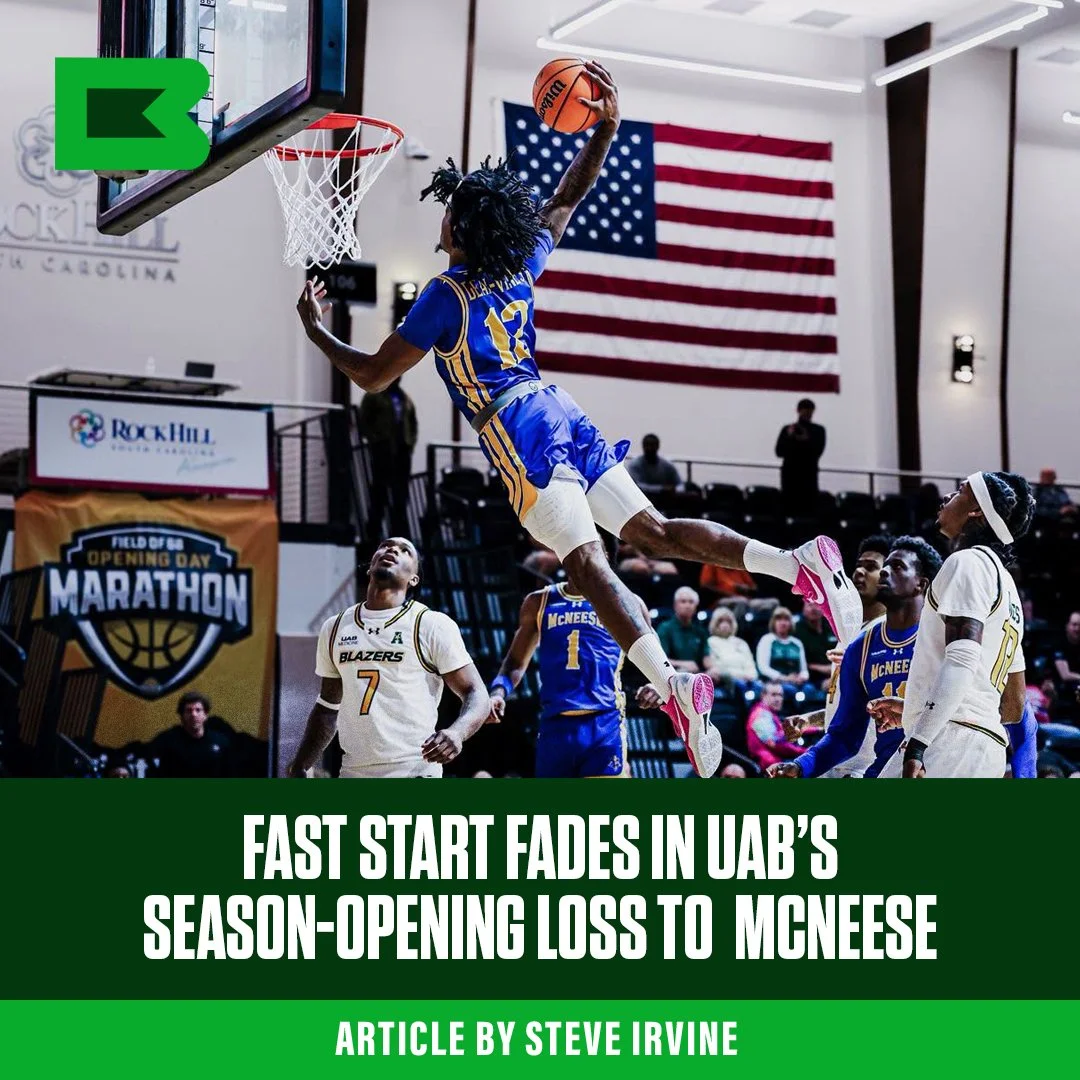
First half turnovers and the inability to get defensive stops in both halves, particularly the second half, were huge stumbling blocks in the UAB mens’ basketball team opening up the 2026-27 regular season with a 99-78 loss to McNeese State on Monday in the Field of 68 Opening Day Marathon at the Rock Hill (S.C.) Sports and Events Center.
“Well, I hate the way that we played, really disappointing,” UAB head coach Andy Kennedy said during his postgame radio appearance on the Blazer Sports Network from Learfield. “Really disappointing and embarrassing on many, many fronts.”
Before the disappointment began, however, UAB burst out of the gates with a pair of 3-pointers by Justyn Fernandez and the Blazers eventually built a 15-6 lead. About that time the disappointment began because the Blazers wilted under the Cowboys’ defensive pressure and had no answer for McNeese State standout Larry Johnson. Mix those two things together and McNeese strung together a 19-1 run to take control.
“I thought we started the game great, came out with some good energy,” said Kennedy, whose team had 11 first half turnovers. “They make a run on us and I thought we made a little run at the end of the first half to stay in there. We had so many turnovers. They were up 21-2 in points off turnovers and second chance points in the first half and we were down by nine (44-35 at half). I told our guys we're fortunate to still be in the game, let's settle in. Our turnover issues kind of got resolved, maybe some at the end of the first half. In the second half, we came out and we let Larry Johnson do what Larry Johnson does.”
Johnson not only finished with a career best 31 points but he also got his teammates going on the offensive end.
“They started playing with great confidence, that rim got real wide,” Kennedy said. “They're not a prolific three-point shooting team but they made 12 tonight. They've got a number of guys that that really rose up and made plays. They hurt us on the backboard. We ended up with only 14 turnovers, but only because at the end, they were just trying to keep us in front of them. Really disappointed in the way that we played. Give McNeese State credit. They’re a good basketball team and I thought they played well today.”
UAB did a good job on the boards early in the game, outrebounding McNeese State 9-2 in the first few minutes, but ended up losing 33-26 in that category. The Cowboys won second chance points, 18-6, and points off turnovers, 18-7. McNeese State also led in blocked shots (8-2), steals (10-5) and assists (20-15).
UAB had five players finish in double figure scoring with Elijah Duval leading the way with 15 points, five assists and two rebounds. Deuce Jones had 12 points, four rebounds and two assists, Fernandez had 11 points and Salim London and TJ Caldwell each added 10 points. UAB made 26-of-30 free throws, which is a 86.7 success rate.
But Kennedy went away from the stat sheet to break down what bothered him most in the season opening loss.
“My biggest frustration is just our lack of awareness, man,” Kennedy said. “This group is crazy in lack of (awareness). I look back, something that we’re doing as a staff is not connecting. We look a step slow. We look confused. We don't really have much of a voice on the court. We've got to get back and get that corrected immediately.”
A big part of that, Kennedy said, needs to come from the UAB players.
“I think this group has got to take more personal ownership of possessions that happen on the floor,” Kennedy said. “I know the best teams are player-led. Right now, we just don't have much of a voice. We’ve got some bad habits that we think that we can just manufacture and play through. We got to be really open about making the steps that are necessary.”
UAB plays its first game in the restructured Bartow Arena on Friday night against Nicholls with opening tip scheduled for 6:30.
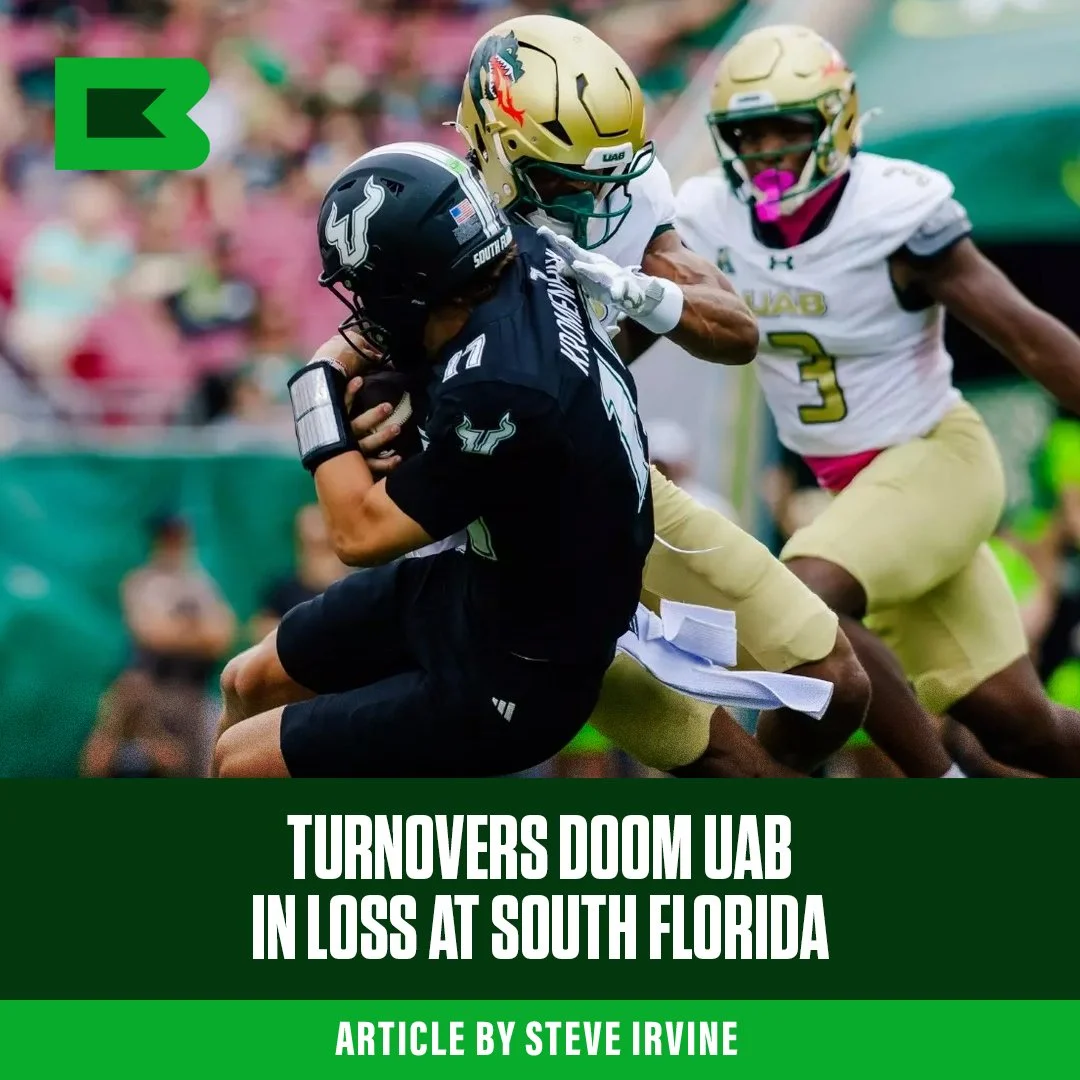
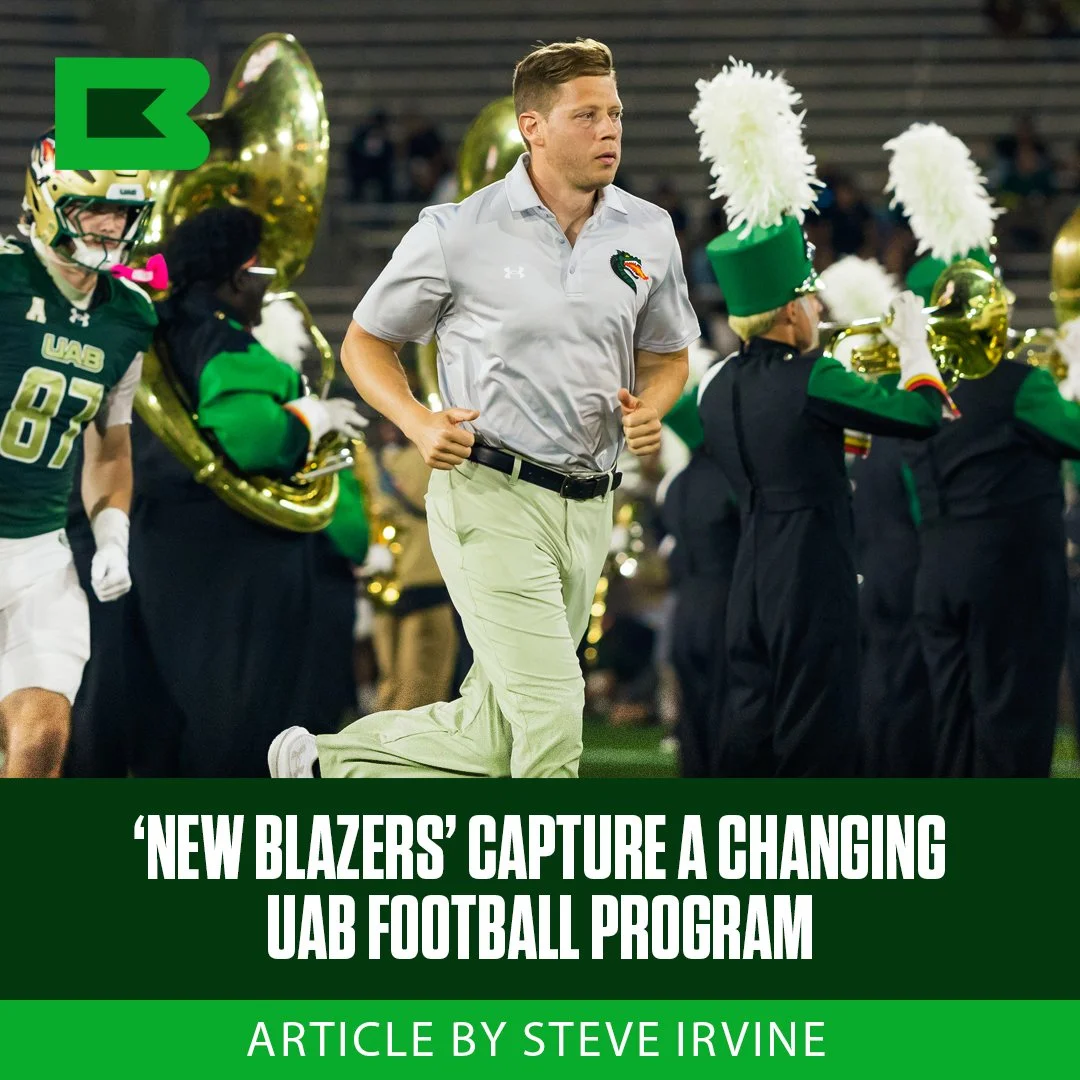
Two words have become the theme of a UAB football season that, for the first time in at least three years, still carries a ton of promise in the early part of the second half of the schedule.
Sometimes the words come with an attached hashtag on social media. Sometimes the words are spoken loudly in the locker room after a win. They may be used on the practice field or during a game. They have become a rallying cry for a team that is working to put three difficult years to rest.
Those two words? “New Blazers.”
Running back Bam McReynolds, who coined the phrase, was asked the importance of those two words.
“I feel like to have that motto, something to say, something that we could fall back on, it gives us a sense of camaraderie,” McReynolds said. “Especially (because) we’ve got a lot of guys that this their first year here. (It’s) a lot of transfers mixed in with a bunch of guys that have been here. They've seen like the ups and downs of the team and I feel like it's very important to have it.”
It wasn’t something that was preceded by much thought. It was something that appeared during a “very high energy competitive practice” during the spring.
“I just remember how UAB (was) in the past,” said McReynolds, a Mobile native who spent three years at South Alabama and last season at Louisiana-Monroe. “I was recruited by UAB and I just knew about previous teams and stuff like that. We kind of use it as a callback to the previous teams. We were having an amazing practice on offense and defense and I think I just said it just to say like this is a new team. Not only this is a new team, but I felt like this is gonna be a very, very high energy team. I feel like we brought that in a lot of the games that we found success in.”
UAB is 4-3 overall heading into Saturday’s American Conference game against South Florida at Raymond James Stadium in Tampa. UAB is 2-1 in American Conference play with both of the wins featuring a gritty come-from-behind effort in the second half. For Alex Mortensen’s UAB team, Saturday’s game gives the Blazers an opportunity to remain in a group of teams bundled toward the top of the conference standings.
Obviously there is a lot of work left but, for Lyle Henley what’s happened thus far is a familiar feeling. Henley, the program’s Director of Sports Performance and Assistant head coach, has been part of the program since the return to the field in 2017. He had an integral role in Bill Clark’s successful run from 2017-21 when UAB played in three Conference USA championship games and won two conference championships. He is one of two people in the program, the other being trainer Dan Springer, who has been with the team every year since the 2017 season.
Henley said this team has some similarities to Clark’s teams.
“I see tough defense being played,” Henley said. “Defense being the trademark. I see kids fighting all four quarters plus, never giving up, not looking at the scoreboard as Coach Mort likes to say. He challenges them to not look at the scoreboard and just play hard, play after play, which is very similar to the mindset we had when we were successful. Yeah, there are a lot of similarities, especially in the physicality I’ve noticed in these kids.”
Henley smiled when the term “New Blazers” was mentioned. He acknowledged it’s an important part of this team’s journey to this point. But he was also a little ahead of the curve when identifying that this team could live up to what the motto means.
“You could see aspects of it early on,” Henley said of a team which largely came to campus for the first time in January. “You could see a core group of kids who stayed here and vowed we were going to turn this thing around. They’ve been here since day one and as these other guys trickled in they didn’t resist against anything the (returning guys) tried to do. The toe-the-line mindset that we had every single day, the attention to detail, the no job is too great, no job is too small (mentality). They didn’t resist any of it. They just jumped in the boat and started rowing in the same direction. So, you could see it. You had hope but now you see it come to fruition.”



Subscribe FOR UPDATES
THE BANNER
The Banner is created for Birmingham’s fans by Birmingham fans with a hope to amplify the athletes, teams, and stories that make this one of America’s best sports cities. Always more than the score.